
A treatment is the film before the film. It is a few pages of prose that let someone else watch the movie that currently exists only in your head. Producers read treatments to decide whether to commit. Cinematographers read them to understand the look. Actors read them to feel the part. Long before a single frame is shot, the treatment is the film, so it is worth writing well.
The good news is that a treatment is not a test of your writing. It is a test of your clarity. If you know what your film feels like, the treatment almost writes itself. If you do not know yet, writing one is the fastest way to find out.
What a treatment actually does
A treatment has one job, to transfer the experience of the film into the reader's head. Not the plot mechanics, the experience. When someone finishes reading, they should know what the film feels like to watch, what world they were in, and why it matters that this film gets made.
That framing changes what you write. A plot summary tells the reader what happens. A treatment makes them feel what it is like when it happens. The difference is the same as the difference between a shot list and the shot.
It also has a second, quieter job. A treatment aligns your team. When the person pulling focus and the person dressing the set have both read the same three pages, a hundred small decisions on the day already point in the same direction.
Start from the feeling, not the format
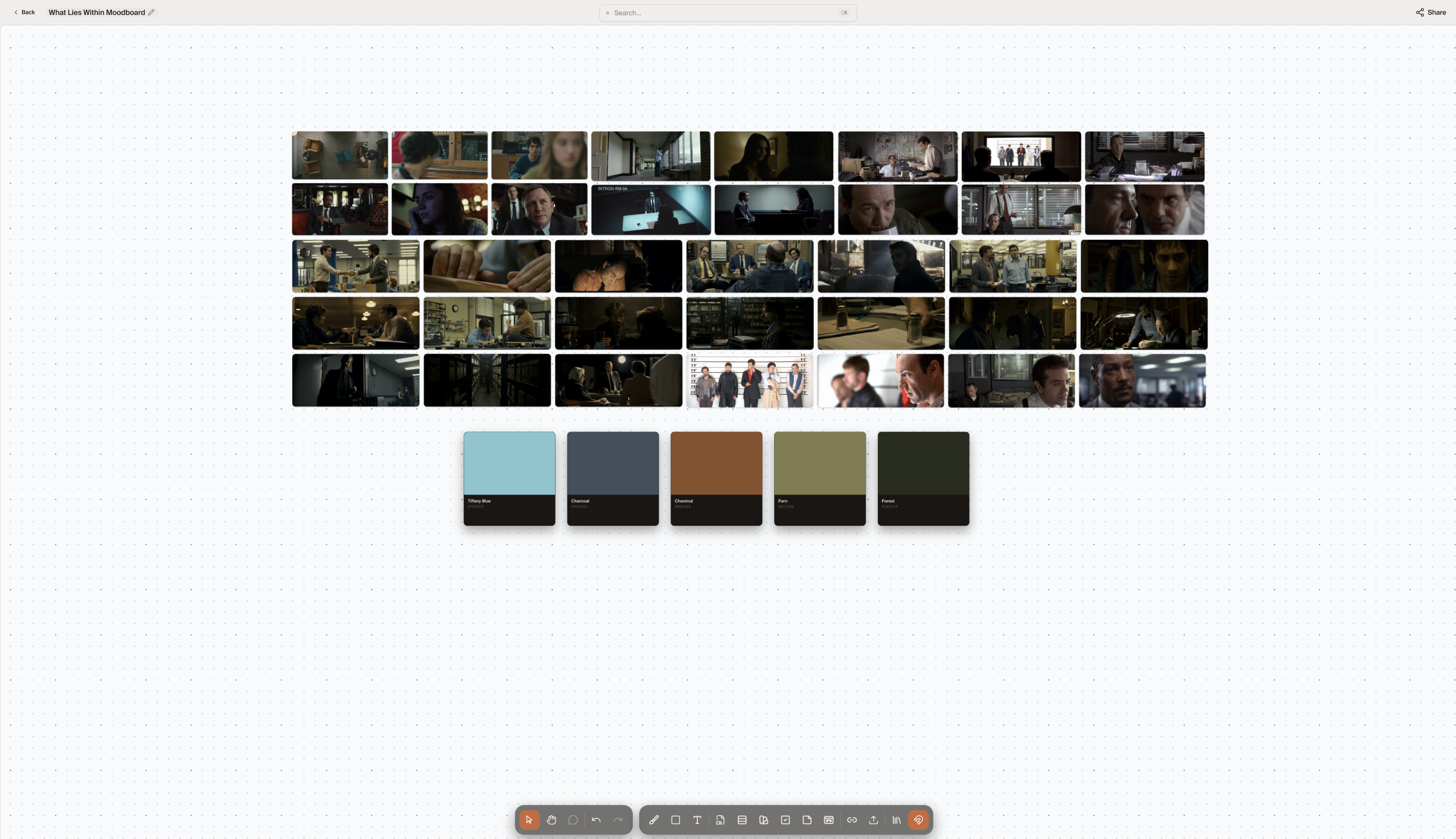
Before you open a blank page, collect. Gather the images, frames, paintings, photographs, and clips that feel like your film. Pull the colours out of them. Put them on one surface where you can see them all at once and move them around until the wall starts to agree with itself.
This is not procrastination. The wall of references is the raw material of the treatment. When you can point at an image and say that is the light in scene four, you are no longer guessing at your own film. Write the treatment with the wall in view, and let the prose borrow its temperature.
The shape that works
There is no official format, and anyone who tells you otherwise is selling a template. But most treatments that work share a shape.
- The opening line. One or two sentences that hold the whole film. What it is about, and what it is really about. If you cannot write this yet, write everything else first and come back.
- The world and the tone. A short paragraph that puts the reader inside the film's atmosphere. Time, place, texture, pace. This is where your references earn their keep.
- The story, told as an experience. The bulk of the treatment. The film from first image to last, in present tense, at the altitude of watching rather than the altitude of explaining.
- The look. How the film sees. Light, palette, movement, framing. Name the references directly, a reader trusts a specific comparison more than an adjective.
- The people. Each principal character in a breath or two. Who they are when the film opens, what the film does to them.
Length depends on the project. A music video treatment might be a page. A feature might run eight or ten. Shorter is almost always stronger, because a treatment is judged by what it makes the reader feel per paragraph, not by how much it covers.
Write it like the film is running
Treatments are written in present tense, because the reader is meant to be watching, not remembering. The film opens. She walks. The room empties. Present tense keeps the prose at the speed of the film.
Stay at the surface of what the audience sees and hears. Interior states belong in the treatment only when the film can actually show them. If the camera cannot see it, the reader should not be told it, they should be made to feel it the way an audience would.
Write the film you can point a camera at, not the film that lives in the footnotes.
And keep the machinery out. Lens choices, act numbers, scene headings, none of that belongs here. The moment a reader notices the format, they have stopped watching your film.
Make the look concrete with references
Every treatment says the film will be visually striking. Almost none of them proves it. Proof is specificity, this street at this hour, this photograph's stillness, this palette pulled from a single frame you cannot stop thinking about.
References work because they compress. One image of a sodium lit underpass tells a reader more about your night scenes than a paragraph of adjectives. Choose a handful that genuinely agree with each other, and cut every reference that is merely impressive. A tight set of five images that share a temperature beats thirty that share nothing.
If your treatment lives next to the wall it grew from, even better. A reader who can drift from the prose to the exact images behind it stops evaluating and starts believing.
Share it early, shape it together
The lonely version of this process goes, write the treatment in private, polish it until it feels safe, then reveal it. The stronger version is the opposite. Share the wall before the treatment exists. Share the first rough page. Let your producer, your cinematographer, your production designer push on the idea while it is still cheap to change.
Feedback at the treatment stage costs a conversation. The same feedback in prep costs a day, and on set it costs the scene. When the people who will make the film with you have shaped the treatment, they arrive already inside it, and the document stops being yours and starts being the film's.
A treatment is also never finished, it is current. The draft that goes to a collaborator on Tuesday should be the same living document they reread on Friday, not a stale attachment three versions behind.
The mistakes that sink treatments
- Summarising instead of showing. If it reads like a synopsis on the back of a case, the reader is being told about the film rather than watching it.
- Vague tone words. Gritty, cinematic, elevated. Every unmade film is all three. Replace the adjective with the image that made you reach for it.
- Length as effort. Ten dense pages do not signal commitment, they signal that the filmmaker has not decided what matters yet.
- A look section with no evidence. If the visual intent has no references behind it, it is a wish, not an intent.
- Keeping it private until it is perfect. Perfect and unread helps nobody. Rough and shared moves the film forward.
From treatment to production
A treatment that works starts pulling the rest of the production behind it. The story paragraphs become scenes, the scenes become a shot list, the shot list becomes a schedule, and the schedule becomes the callsheet that gets everyone to the right place at the right hour.
That pull is why the treatment deserves to live where the rest of the film lives. CineFlow is the creative space where filmmakers develop ideas into films, together. When the references, the treatment, the shot list, and the schedule share one connected place, a change made in the idea reaches the set without anyone forwarding a file. That is the whole point of writing it down in the first place, one version of the film, held in common, from the first image on the wall to the last day of the shoot.
So collect the wall, write the film in present tense, keep it short, and hand it to your crew while it is still warm. The treatment that gets a film made is rarely the most polished one. It is the one that lets everyone see the same film, early enough to go make it.